
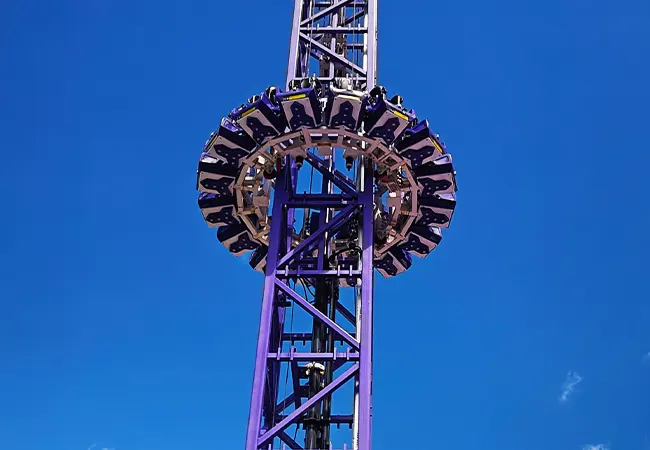
Drop towers rise, drop, and stop using either a gravity-driven or a pressure-driven system. Both types follow the same cycle of rising, dropping, and stopping, but the drive decides how the drop feels. Gravity gives a true free fall, while pressure lets operators tune the ride. This article explains how each type works, what parts make up the ride, how the ride feels, and how its safety systems protect passengers.
How Does a Drop Tower Rise, Drop, and Stop?
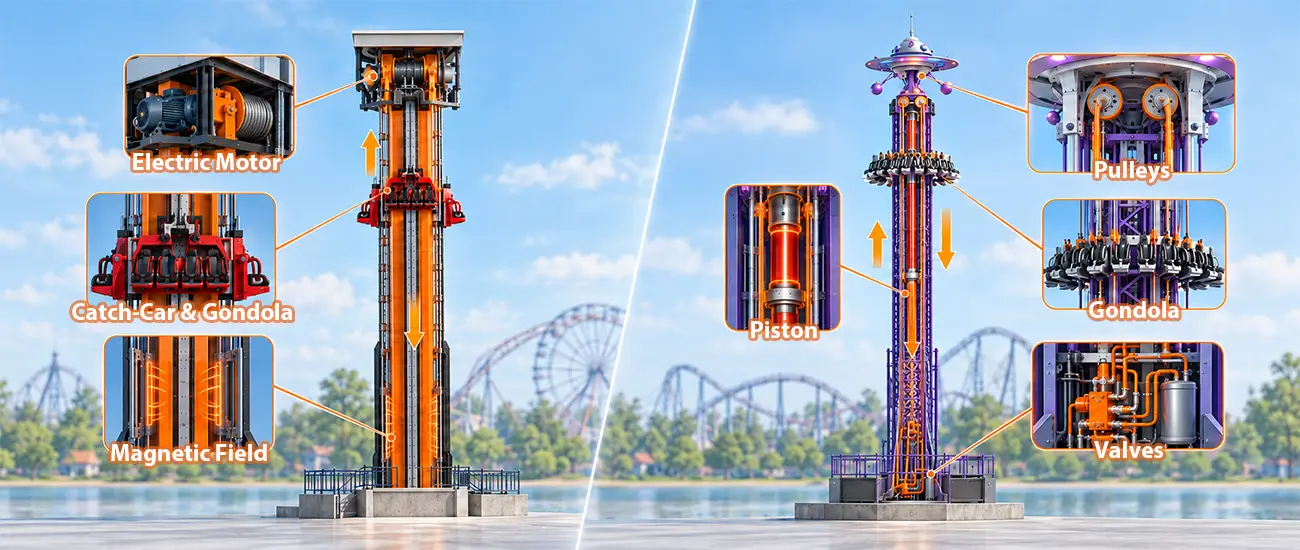
A gravity-driven drop tower uses a motor to lift, gravity to drop, and magnets to slow, while a pressure-driven drop tower controls all three phases using a single pneumatic or hydraulic system. Some models run this cycle once per ride, while others can repeat the up-and-down movement several times. Below is a comparison of how the two drive types work.
| Key Differences | Gravity-Driven Drop Tower | Pressure-Driven Drop Tower |
|---|---|---|
| Rise | A motor-driven catch-car hauls the gondola up | Air or oil pushes a piston, and connected cables pull the gondola up |
| Drop | The catch car’s latch releases and gravity pulls the gondola down | Valves release pressure and lower the gondola under control |
| Stop | Magnets slow the gondola near the bottom | Valves regulate pressure to slow the gondola |
| Nature of the Drop | A true free fall | A controlled drop shaped by the drive system |
| Drop Speed | Set by gravity and increases as the gondola falls | Set by the drive system and adjustable |
| Drops per Ride | Typically only one drop from top to bottom | Can repeat up-and-down movements for a bounce effect |
| Examples | Intamin Giant Drop | S&S Turbo Drop (pneumatic), Beston ZERO-G Elevator (hydraulic) |
Gravity-Driven Drop Tower
In a gravity-driven drop tower, a motor-driven lifting carriage called a “catch-car” latches onto the gondola and hauls it to the top. Then the latch opens and gravity takes over, giving a true free fall.
Near the bottom, magnets on the gondola sweep past the metal plates fixed on the tower. They never touch, yet the plates generate a powerful opposing magnetic field pushing the gondola back like an invisible cushion. The faster the gondola moves, the stronger the push. As it slows, the push fades, so the gondola eases down smoothly.
Pressure-Driven Drop Tower
A pressure-driven drop tower is powered by compressed air (a pneumatic system) or by oil (a hydraulic system), with a single system controlling movement throughout the entire ride.
The air or oil fills a cylinder inside the tower and pushes a piston. Steel cables run from the piston over pulleys at the top to the gondola, so when the piston moves one way, the gondola moves the other, like two buckets on a well rope. Valves adjust the pressure to control the piston, and consequently control the gondola’s movement from start to finish.
What Parts Make a Drop Tower Work?
A drop tower works with three groups of parts: the tower, the gondola, and the drive and control system.
The Tower
The tower is a tall steel frame that holds everything up. Many towers use strong vertical columns joined by cross braces, and typically stand on deep concrete foundations. The tower also guides the gondola, keeping it on a straight path as it travels up and down.
The Gondola
The gondola is the seating unit that travels up and down the tower. Seats are usually arranged in a ring around the tower and face outward, so passengers experience a more thrilling visual effect. Each seat has a safety restraint that holds passengers in position.
The Drive and Control System
- Drive System: Moves the gondola. In gravity-driven models, it consists of catch cars and magnetic brakes. In pressure-driven models, it includes cylinders, cables, pulleys, and valves.
- Control System: A programmable logic controller (PLC) tells the drive system when to start and stop.
What Does a Drop Tower Ride Feel Like?
A drop tower ride feels like a slow, tense climb, a few seconds of weightlessness, and a smooth, firm stop. On a pressure-driven tower, the drive can tune this feel from gentle to intense.
Rising to the Top
Once passengers are seated and locked in by their safety restraints, the gondola is lifted up the tower, usually at a speed much slower than the drop. Passengers watch the ground shrink below and feel the tension build. At the top, the gondola halts for a few seconds. Passengers know the drop is coming, but not exactly when.
Dropping Down
The gondola then leaves the top and plunges. This is the shortest phase of the ride, usually just a few seconds. Passengers feel the seat stop supporting their bodies, which is the feeling of weightlessness. Wind rushes up from below and the ground races closer, making those few seconds feel much longer.
Slowing to a Stop
As the gondola approaches the bottom, its speed is gradually reduced, since a sudden stop would be harsh on passengers. The seat supports their bodies again and presses them back into place. Once the gondola settles at the loading level, the restraints unlock, passengers exit, and the next group takes their seats.
How Does a Drop Tower Keep Passengers Safe?
A drop tower keeps passengers safe through several layers of protection. Some are shared by both types, while others vary depending on the type.
Shared Safeguards on Both Types
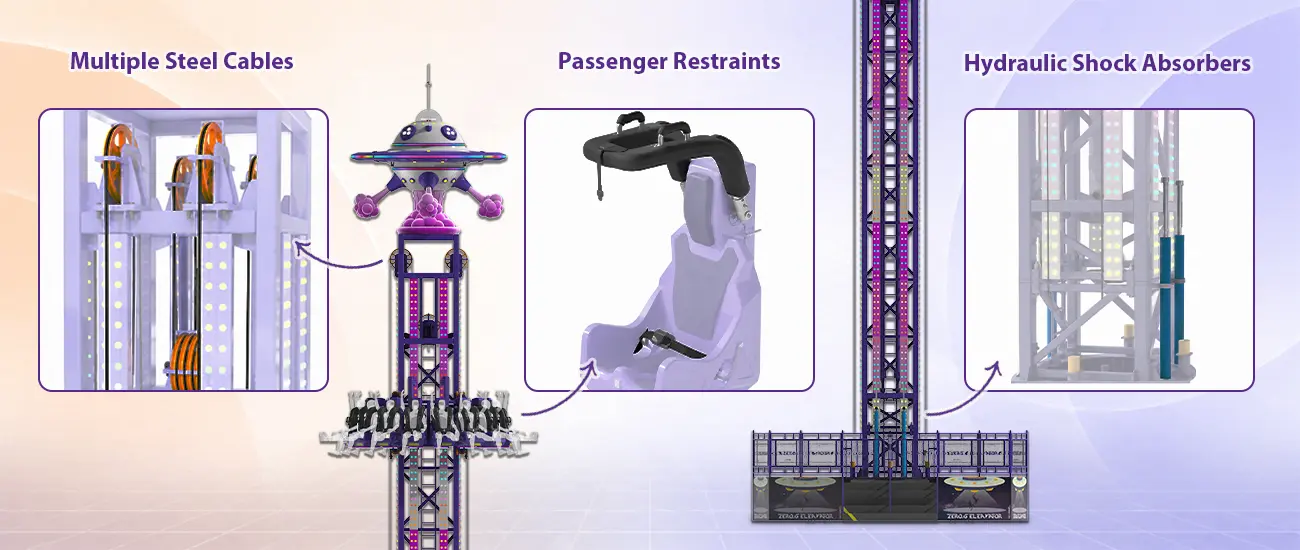
- Passenger Restraints: A safety harness holds each rider in the seat. Some models add seat-belts or even auxiliary straps for extra protection.
- Sensors and Control System: Sensors monitor restraint status and gondola speed. If any data is abnormal, it stops the ride for safety.
- Shock Absorbers (Buffers): Typically made of hydraulic cylinders, they give the gondola a final catch in case the brake system fails.
Type-Specific Safeguards
- Magnetic Brakes: On gravity-driven models, the braking force comes from the magnets, not from electric power. So even in a power loss, the gondola still slows down and passengers can descend safely.
- Multiple Cylinders and Steel Cables: On pressure-driven models, there are more cylinders and cables than normal operation requires. The extra ones serve as backups, so if one fails, the rest can still hold the gondola.
Two Drive Types, One Thrilling and Safe Ride
Whether gravity-driven or pressure-driven, every drop tower delivers its thrill the same way: lift the gondola, drop it, and slow it with precisely controlled parts. The difference lies in whether separate components do the work or a single system provides more flexible control. That flexibility is the main reason Beston 35m ZERO-G Elevator uses a pressure-driven design. As a member of IAAPA and RAAPA, Beston Rides builds its drop towers around strict engineering and safety requirements, delivering joy to visitors worldwide.