
A roller coaster works by converting an initial input of energy into controlled motion through gravity and track design. To fully understand how a roller coaster works, it is important to look at how energy, mechanical systems, and safety features interact throughout the ride and create different riding experiences. This article guides you from the science and technology behind roller coaster operation to the forces riders experience.
How Does a Roller Coaster Work Without a Continuous Engine
Unlike a car, a roller coaster has no engine running throughout the ride. Instead, it relies on one core principle: energy conversion. The train receives a single burst of energy at the start, then coasts through the entire circuit by continuously converting that energy between two forms—stored energy from height (potential energy) and energy of motion (kinetic energy)—until it eventually runs out and returns to the station. This process unfolds in three stages:
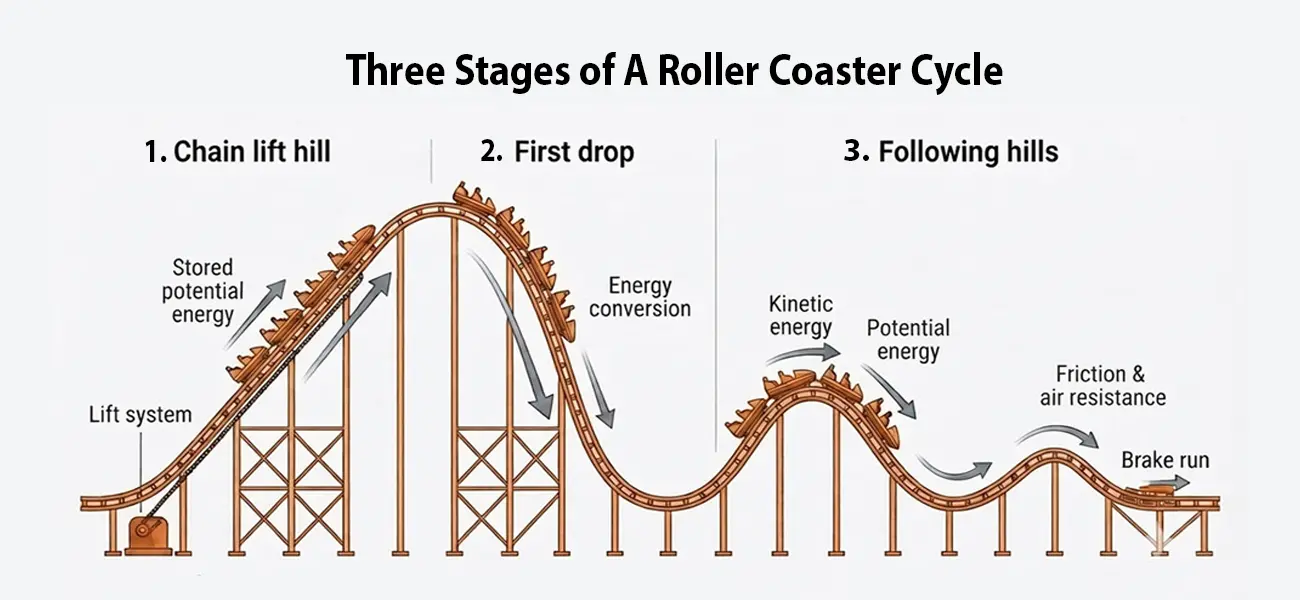
Stage 1: The Chain Lift Hill
A mechanical chain lift pulls the train up the first hill, gradually loading it with potential energy—the higher it climbs, the more energy it stores. This is the only point in the ride where an external mechanism actively adds energy to the system.
Note: Some modern coasters use launch systems to accelerate the train rapidly instead of using a traditional chain lift hill.
Stage 2: The First Drop
As the train plunges down the steep first drop, its stored potential energy rapidly converts into kinetic energy.
This drop is typically the tallest point on the track, because it must supply enough energy to carry the train through every hill, turn, and loop that follows.
Stage 3: The Following Hills
Going through the following hills, the train keeps converting energy back and forth — kinetic to potential on the way up, potential to kinetic on the way down.
This exchange isn't perfectly efficient — friction and air resistance steadily drain part of the energy as heat. So each hill is built a little lower than the last, and the train gradually loses speed until it stops.
How Roller Coaster’s Key Components Work Together to Make It Run
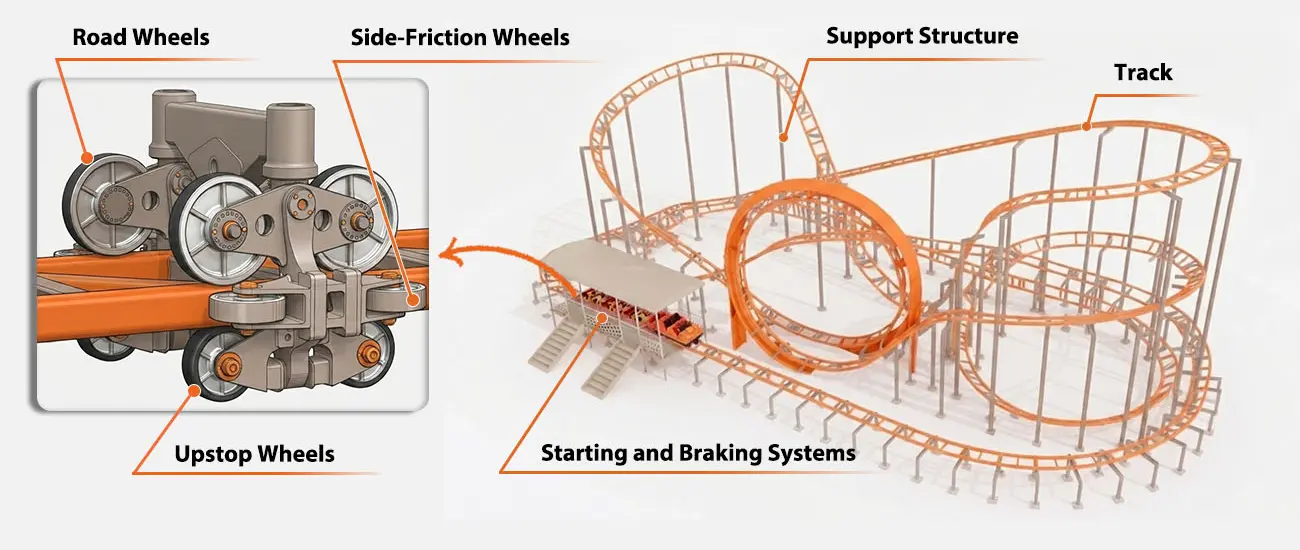
Beyond energy conversion, a roller coaster depends on three physical systems working in sync throughout the ride: the track and support structure, the wheel system, and the starting and braking systems. Together, they turn stored energy into a controlled, continuous motion from start to finish.
Track and Support Structure: What Holds the Ride Up
- Track: The path the roller coaster follows. Shaped to guide it through every drop, turn, and loop.
- Support Structure: The steel columns and beams underneath the track. They carry the track’s weight and keep the whole ride steady.
Wheel System: What Grips the Track
Each coaster car connects to the track through a three-part wheel system known as a bogie. Every wheel type plays a distinct role:
- Road Wheels: Roll along the top of the track. They bear the weight of the car and its riders.
- Side-Friction Wheels: Run along the sides of the track. They keep the car centered through every curve.
- Upstop Wheels: Located underneath the track. They hold the car in place and prevent it from falling off the track during inversions.
Starting and Braking Systems: What Controls Movement
Alongside these structural components, two control systems govern how the ride begins and ends.
- Starting System (Propulsion System): What makes a roller coaster move at the start. It uses either a chain lift system to pull the train upward or a launch system to accelerate them directly.
- Braking System: Brings the train to a stop. Different designs may use magnetic brakes for smooth deceleration or friction brakes for more direct, controlled stopping.
How Do Roller Coasters Work Safely
Beyond the mechanics that keep it moving, a roller coaster relies on four dedicated safety systems. Each system has a specific role in preventing risks and maintaining safe movement.
Seat Restraint System
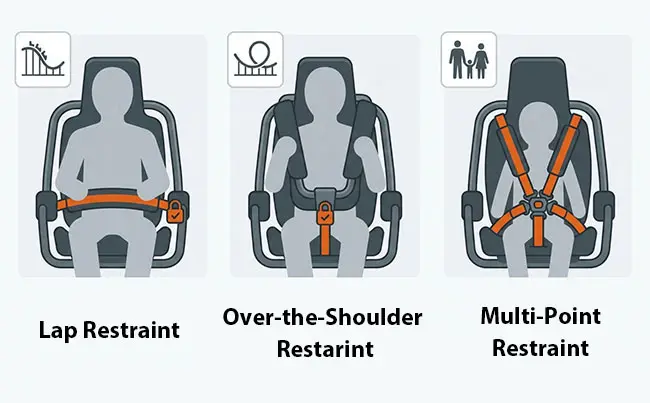
Depending on the coaster type, there are three restraint designs to choose from:
- Lap Restraint: A rigid bar that mechanically locks across the rider’s lap. Used mainly on relatively mild coasters without inversions.
- Over-the-Shoulder Restraint: A harness that locks down over the shoulders to enclose the upper body. Used on extreme roller coasters.
- Multi-Point Restraint: A belt system with multiple anchor points to secure the body across several areas. Used on family coasters to secure smaller riders.
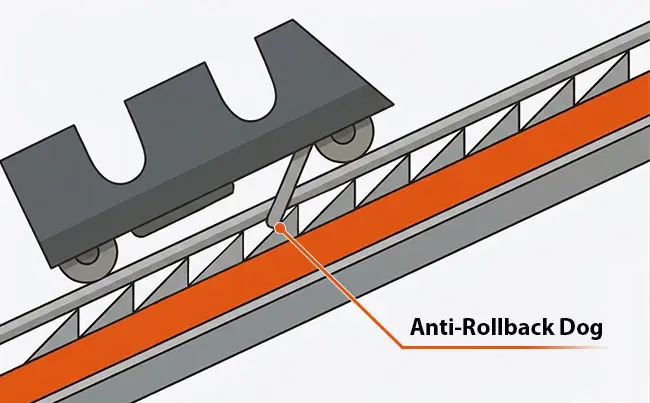
Anti-Rollback System
- Position: Includes a mechanical locking device (often called anti-rollback dogs) underneath the car, and a ratcheted track along the lift hill.
- Function: Prevents the car from rolling backward during the climb, even if power is lost mid-climb.
- Mechanism: As the car climbs, the mechanical locking device physically engages with the ratcheted track, holding the car in place through mechanical force, with no dependence on electrical power.
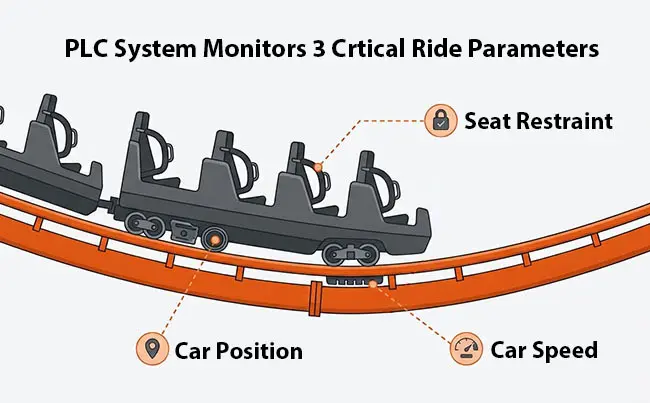
Ride Monitoring System
- Position: Sensors placed across the track, cars, and restraints, all connected to a central control system (a PLC, or programmable logic controller).
- Function: Monitors how roller coaster works by continuously checking critical ride parameters (including car position, speed, seat restraint status).
- Mechanism: Sensors continuously send real-time data to the central control system. If any parameter falls outside a safe range, the system triggers an alarm or halts the ride.
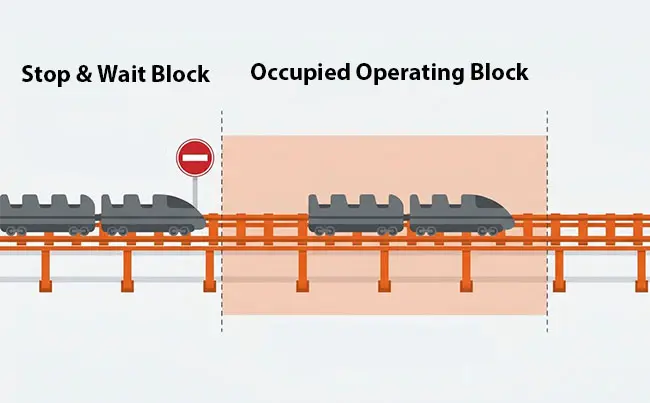
Block Braking System
- Position: Independent track sections (blocks) spanning the entire layout.
- Function: Manages multiple cars running simultaneously on the same track layout and prevents collisions.
- Mechanism: Divides the entire track into several blocks; if a block ahead is occupied, the system holds the trailing cars in the previous block until the track clears.
How Roller Coaster Movements Create Different Sensations
Understanding how roller coasters work also explains why riders feel different sensations during changes in speed and direction.
Going Over Hills: The Floating Feeling
-
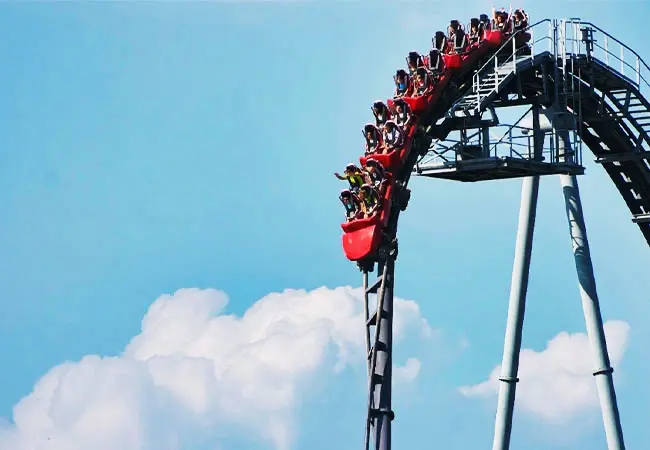
- As the car speeds over the top of a hill, the track curves downward beneath it while riders’ bodies keep moving upward for a split second. This brief mismatch in direction creates a weightless, floating
- sensation that lifts riders slightly out of their seats.
Swooping Out of Drops: The Heavy Pressure
- At the bottom of a drop, the track curves back upward while riders’ bodies continue moving downward, resisting the sudden change in direction. That resistance is felt as heavy pressure, pressing riders deep into their seats.
Taking Sharp Turns: Smooth Inward Pressure
- Going into a sharp curve, the track banks—tilting inward so the car leans into the turn rather than staying flat. This banking redirects the force, pushing riders securely into their seats instead of shoving riders violently sideways.
Flipping Upside Down: Jolt-Free Loop Thrills
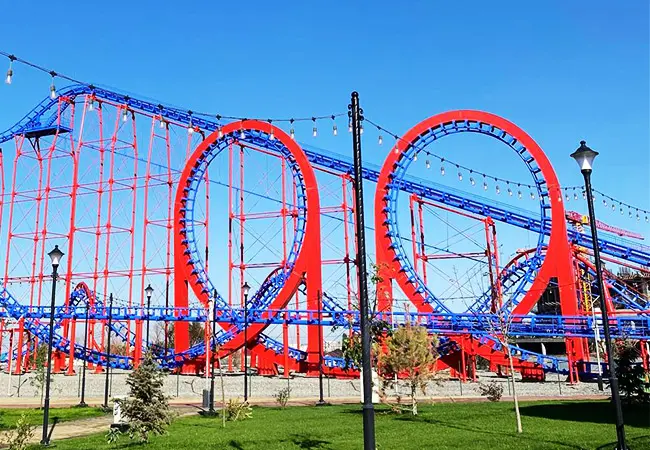
- Rather than a perfect circle, most loops are shaped like a reversed teardrop. This shape lets the force build up gradually as the car moves through the loop, delivering an intense inversion thrill without the harsh jolt a perfectly circular loop would cause.
An Unexpected Health Benefit of Roller Coaster Motion
The science behind how roller coasters work goes beyond creating thrilling experiences. The forces and vibrations during the ride can also affect the human body in surprising ways — they can help small kidney stones pass.
A 2016 Michigan State University study tested this using a 3D-printed model kidney containing real kidney stones, carried through 20 rides on a moderate-intensity roller coaster. The results showed a 64% stone-passage rate in the rear seats—where motion is roughest—compared to just 16% in the front. (Explore more →)
The Science of Roller Coaster Behind Every Scream
Learning how roller coasters work requires looking at the ride as a complete system. From the energy that sets it in motion, to the mechanical components that hold it together, to the safety systems that keep every ride under control, each element is engineered to create a controlled and thrilling experience.
For amusement parks, translating these principles into a safe, reliable ride depends on choosing a manufacturer with proven technical expertise. By combining time-tested engineering principles with modern technology, Beston Rides designs and delivers custom coaster solutions built to meet diverse park requirements—creating rides that keep visitors coming back for the thrill, worldwide.